
Detached Garage and Shop Wiring
What to Plan For
Getting power to a detached structure is more than running a wire. Sub panel, trench, grounding, permits, and the right circuits for how you'll actually use the building. Here is the full playbook for Clark and Cowlitz County.
Quick Answer
Powering a detached garage or shop requires a buried feeder from the main house panel, a sub panel at the structure sized for the planned loads (typically 60-100 amps), grounding electrodes at the detached building per NEC 250.32, and a Washington State L&I permit. Plan the sub panel size around what you'll actually use: a simple two-car garage works on 60 amps; a working shop with welders, air compressors, and an EV charger needs 100 amps.
Outbuilding electrical is one of the most common requests Newman Electric gets from homeowners in rural Clark County and Cowlitz County. Battle Ground, Brush Prairie, Hockinson, Ridgefield, La Center. These are areas with properties that have detached garages, shops, barns, ADUs, and outbuildings of every shape. Customers want real power out there: not an extension cord from the house, not a single 15-amp circuit, but a proper sub panel and circuits that can handle a welder, a compressor, an EV charger, or an ADU's worth of load.
Done right, a detached garage job runs cleanly, passes inspection, and lasts 30+ years without issues. Done wrong, it's a fire hazard, fails inspection, or trips constantly. Here's what goes into planning it correctly.
Step 1: Figure out the sub panel size you actually need
The sub panel is the core decision. Undersize it and you'll max out the moment you add an EV charger or a table saw. Oversize it and you're paying for copper and breakers you'll never use.
30-amp sub panel: minimal
Enough for lights, a couple outlets, and a garage door opener. Not enough for anything with a motor load of significance. Only makes sense for a small outbuilding used for storage.
60-amp sub panel: standard detached garage
The baseline for most two-car detached garages. Handles lights, outlets, a garage door opener, and either an EV charger OR a 240V tool circuit but usually not both at high amperage. Common and cost-effective.
100-amp sub panel: shop or future-proofed garage
The right size for a working shop with welder, compressor, table saw, and an EV charger. Also the right size for any ADU. Leaves headroom for future additions. Most of the detached garage jobs Newman Electric does today are 100 amps because EV chargers have become almost standard.
125-200 amp sub panel: serious workshop or large ADU
Used when the outbuilding has kitchen, laundry, mini-split, and multiple 240V tool circuits. Full ADU territory. Also fits rural properties running well pump, irrigation, and shop from a single outbuilding feed.
Step 2: Plan the feeder run
The feeder is the wire that runs from the main panel at the house to the sub panel at the outbuilding. Three things to decide:
- Path: overhead (on a messenger cable or masthead) or underground (buried in conduit or direct-burial cable). Underground is the standard residential approach in the Pacific Northwest; overhead is rare on new installs.
- Conduit type: PVC schedule 40 is standard for residential underground runs. Schedule 80 where the conduit comes up out of the ground. Direct-burial USE cable without conduit is an option but less common and harder to upgrade later.
- Trench depth: 18 inches minimum for PVC conduit with circuits over 30V, 24 inches for direct-burial (NEC Table 300.5). In practice we dig 24 inches for everything because Pacific Northwest soil settles and a shallower trench can fail a future landscaping project.
Step 3: Size the wire for voltage drop, not just ampacity
NEC minimums get you a wire that won't overheat. Voltage drop math tells you whether that wire delivers usable voltage all the way to the shop.
Rule of thumb: at 100 feet the minimum-code wire is usually fine. At 150 feet you often need to go up one size. At 250+ feet the upsize is mandatory; otherwise a motor load at the sub panel will brown out under start current.
| Sub panel | Distance | Typical wire (copper) |
|---|---|---|
| 60 amp | Up to 100 ft | 6 AWG |
| 60 amp | 100-175 ft | 4 AWG |
| 100 amp | Up to 150 ft | 2 AWG or 1 AWG |
| 100 amp | 150-250 ft | 1/0 AWG |
| 100 amp | 250+ ft | 2/0 AWG or larger |
Aluminum conductors are often used on longer runs to reduce cost. Sizing goes up roughly one gauge compared to copper for equivalent ampacity.
"Very professional, responsive and right on schedule. Very clean job and quite reasonably priced, especially considering this was not a very big job. Ran 50 amp service from house panel to sub panel in shop."
Maritsa Bowman, Google Review
Step 4: Ground the outbuilding correctly
NEC 250.32 is specific about how to ground a sub panel at a detached structure. Two key rules that catch DIY jobs:
- Drive grounding electrodes at the detached building. Usually two 8-foot copper-clad ground rods, 6+ feet apart, bonded to the sub panel's ground bar.
- Do NOT bond neutral to ground in the sub panel. The neutral bar and ground bar must be separate (remove the bonding screw). Neutral bonding only happens at the main panel at the house.
This is one of the most common code violations the L&I inspector flags on DIY garage jobs: the electrician installed a main panel at the garage instead of a sub panel, so neutral and ground are bonded. The fix is cutting the bonding strap and adding the ground rods.
Step 5: Plan the inside circuits for real use
Once the sub panel is energized, the circuits inside the building should match how you'll actually use it. Typical residential detached garage:
- 2x 20-amp general receptacle circuits (outlets around the perimeter, every 6-12 feet)
- 1x 20-amp lighting circuit (LED shop lights, garage door opener outlet)
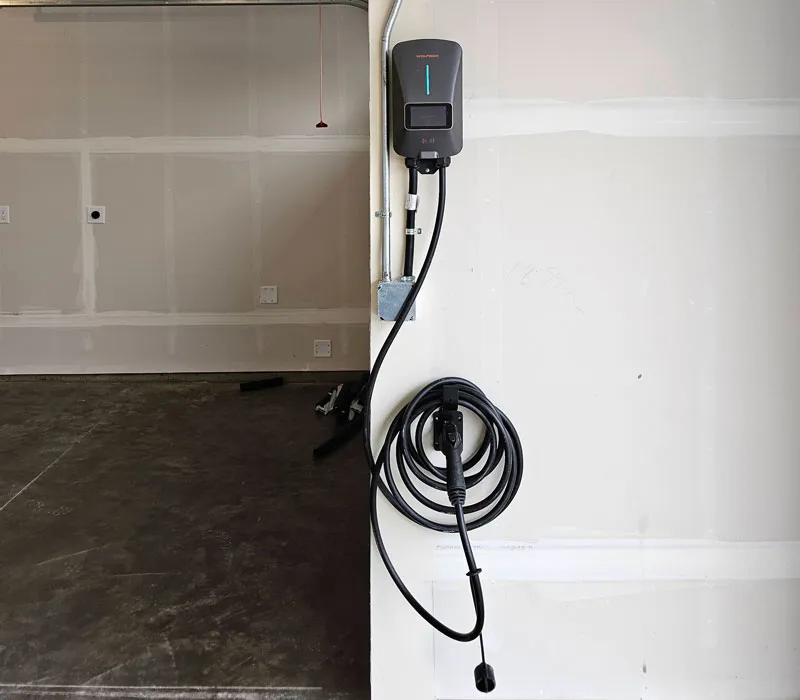
- 1x 240V circuit for EV charger (40 or 50 amp)
- 1x 240V circuit for shop tools (30 or 50 amp) if it's a workshop
- 1x dedicated 20-amp circuit for a freezer or second refrigerator if applicable
- GFCI protection on all receptacles per NEC 210.8(A)(2)
Tell the electrician what you'll actually do in the building, not just the square footage. A "car storage + occasional DIY" garage needs different circuits than a "full-time welding and fabrication shop."
Common mistakes to avoid
- Skipping the permit. Fine on a small interior circuit change; catastrophic on a new feeder. Insurance and resale issues follow.
- Running a single 20-amp 120V extension from the house. Not only undersized, also a code violation.
- Sizing the sub panel too small. Upgrading a 60-amp panel to 100-amp later means re-digging the trench and replacing the feeder.
- Forgetting GFCI protection. Every outlet in a detached garage is required to be GFCI-protected.
- Installing a main panel instead of a sub panel at the building. Neutral-ground bond in the wrong place is a shock hazard.
- Going too shallow on the trench. Future landscaping, fencing, or tree roots can damage a shallow conduit run.
Frequently Asked Questions
How much does it cost to run power to a detached garage?
$2,500-$6,500 in the Vancouver WA area depending on distance, sub panel size, trenching, and interior circuits. Short runs with 60-amp panels are on the low end; long runs to full-shop 100-amp panels are on the high end.
What size wire do I need to run to my detached garage?
Depends on sub panel amperage and distance. 60-amp under 100 ft is 6 AWG copper; 100-amp under 150 ft is 2 AWG copper. Long runs require upsizing to hold voltage.
Does a detached garage need its own grounding electrode?
Yes. NEC 250.32 requires ground rods at the detached structure. Neutral and ground stay separate at the sub panel; bonding only happens at the main panel.
Do I need a permit to wire a detached garage in Washington?
Yes. All new feeders and circuits to detached structures require L&I permits (or City of Vancouver if inside city limits). Newman Electric files permits and schedules inspections.
Can I run an EV charger in my detached garage?
Yes, and it's one of the most common reasons for new garage feeders. Plan on a 100-amp sub panel so the charger plus lights, outlets, and other loads fit comfortably.
Can I use a generator with a detached garage sub panel?
Yes, via an interlock kit or transfer switch at the main panel. Both house and garage receive backup power during an outage.
Related Services
Electrical Panel Upgrade
Sub panels and main panel upgrades for outbuilding feeds
EV Charger Installation
Level 2 chargers in detached garages and shops
Dedicated Circuits
240V tool circuits and high-amp appliance circuits
Generator Installation
Backup power for house + outbuilding
Electrical Code Compliance
L&I permits and inspection for new feeders
Battle Ground Service Area
Rural Clark County where shop wiring is common
Wiring a shop, garage, or ADU?
Newman Electric runs feeders and sub panels to detached structures across Clark County, Cowlitz County, and rural Vancouver WA. We do the trench coordination, conduit, sub panel, grounding, and interior circuits. Free estimate, permits included.
More Guides
Keep Reading
Dryer, Range, and Oven Outlets: A 240V Appliance Circuit Guide
NEMA 14-30 vs 10-30, 50-amp range circuits, and why new installs need 4-prong outlets. Dryer, range, oven, and dishwasher circuit rules explained.
Heat Pump and Mini-Split Electrical Requirements
Heat pumps need a 240V dedicated circuit, a weatherproof disconnect, and often a panel upgrade. Circuit sizing, disconnect rules, and what a real install involves.
Smart Home Wiring Guide: What Your Electrician Needs You to Know
Neutral wire requirements, smart switch compatibility, WiFi vs Zigbee vs Z-Wave, and when you actually need an electrician.