How to Choose the Right
EV Charger for Your Home
You bought the car. Now you need to charge it at home without blowing your budget or undersizing the equipment. This guide covers the decisions that matter.
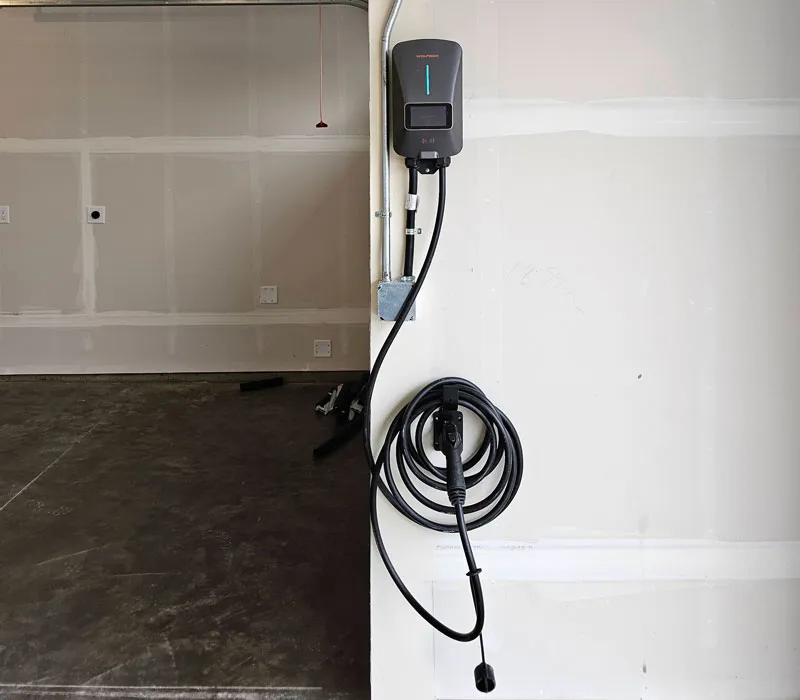
Newman Electric installs EV chargers across Clark County and Cowlitz County every week. Teslas, Rivians, Ford Lightnings, Chevy Bolts, Hyundai Ioniq 5s. Ryan Newman says the question is always the same: "Which charger should I get?"
The answer depends on your car, your driving habits, your panel capacity, and whether you want the charger to be permanent or portable. None of these decisions are complicated once you understand the options.
Level 1 vs Level 2: the speed difference is enormous
Every EV comes with a Level 1 charger that plugs into a standard 120-volt outlet. That's the one most people start with. It works, but it's slow.
| Level 1 (120V) | Level 2 (240V) | |
|---|---|---|
| Miles of range per hour | 3 - 5 | 25 - 50 |
| Time for a full charge (60 kWh battery) | 40 - 50 hours | 6 - 10 hours |
| Circuit required | Standard 15/20-amp | Dedicated 40 or 60-amp 240V |
| Equipment cost | Included with car | $300 - $700 |
| Best for | PHEVs, very short commutes | All-electric vehicles, daily drivers |
If you drive 40+ miles a day, which is most commuters in the Vancouver WA area heading to Portland and back, Level 1 will not keep up. You'll come home, plug in, and wake up to find the car only recovered half the range you used. Level 2 is the standard for daily EV driving.
Hardwired vs plug-in: it depends on whether you'll move
A hardwired charger is permanently wired directly into a dedicated circuit. The cable goes from the panel to the charger with no plug in between. It's the cleanest installation and the most reliable long-term because there's no outlet connection to degrade.
A plug-in charger uses a NEMA 14-50 outlet (the same kind used for electric ranges and dryers). You plug the charger into the outlet. If you sell the house or move, you unplug the charger and take it with you. The outlet stays for the next owner.
Ryan recommends hardwired for homeowners who plan to stay. If you're renting or think you might move in the next few years, plug-in gives you flexibility. Both are safe and code-compliant. Newman Electric installs both styles daily.
How many amps you actually need
Charger amperage determines how fast you charge. More amps means more power delivered per hour. But the charger can only pull as many amps as the circuit allows, and the circuit can only handle what the panel supports.
32-amp charger on a 40-amp circuit
Delivers about 7.7 kW. Adds roughly 25 to 30 miles per hour. Good enough for most daily drivers. Lower installation cost because the wire gauge is smaller.
40-amp charger on a 50-amp circuit
Delivers about 9.6 kW. Adds roughly 30 to 35 miles per hour. A solid middle ground that works for longer commutes and larger battery vehicles.
48-amp charger on a 60-amp circuit
Delivers about 11.5 kW. Adds roughly 35 to 50 miles per hour. The fastest Level 2 speed available. Ideal for trucks (F-150 Lightning, Rivian) and anyone who wants the fastest overnight charge. Requires heavier gauge wire and more panel capacity.
Your vehicle's onboard charger also limits the speed. A car with a 32-amp onboard charger won't charge faster even if you install a 48-amp wall unit. Ryan's crew checks your vehicle's spec to make sure the charger you buy matches what the car can actually accept.
"The install of my level 2 EV charger was seamless. The job was scoped, scheduled and completed within 1 week of my initial call to Newman. The electrician doing the installation was courteous and efficiently completed his work within his estimated time frame. He left the job site clean and the charger ready to go."
Rhadames Carmona, Google Review
Popular home EV chargers Newman Electric installs
Tesla Wall Connector
48 amps, hardwired. Supports up to 11.5 kW. Built-in WiFi for scheduling and monitoring. Works with all Tesla models at full speed, and charges non-Tesla EVs via the J1772 adapter. Clean, flush-mount design.
ChargePoint Home Flex
Up to 50 amps, plug-in or hardwired. Adjustable amperage from 16 to 50 amps. Works with the ChargePoint app for scheduling, energy tracking, and Alexa integration. Charges all EVs with a J1772 connector.
Grizzl-E Classic
40 amps, plug-in or hardwired. No smart features, but built like a tank. NEMA 4 rated for outdoor use. Adjustable amperage via internal DIP switches. Popular with people who want reliability without the app.
Newman Electric installs whatever charger you buy. If you're not sure which one to get, Ryan can recommend one based on your car, your driving pattern, and your budget. The crew installs all of these on a regular basis across the Vancouver WA area.
Check your panel first
A Level 2 EV charger needs a dedicated 240-volt circuit. That circuit uses 40 to 60 amps of panel capacity. If your home has a 100-amp panel that's already near capacity, you may need a panel upgrade before the charger can be installed.
Newman Electric checks your panel capacity during the free estimate. If you need an upgrade, Ryan's crew handles both the panel and the charger install so you're not coordinating between two contractors. Many homeowners in the Vancouver WA area pair a 200-amp panel upgrade with their EV charger installation to future-proof the whole system.
Frequently Asked Questions
What is the best home EV charger?
For Tesla owners, the Tesla Wall Connector is the best match. For non-Tesla EVs, the ChargePoint Home Flex and Grizzl-E are consistently top-rated. Newman Electric installs all major brands and can recommend the right one for your vehicle and electrical setup.
Do I need Level 2 or is Level 1 enough?
Level 1 adds 3 to 5 miles per hour. If you drive under 30 miles a day, it might work. Most EV owners find it too slow within the first few months. Level 2 adds 25 to 50 miles per hour and is the standard for daily driving.
Should I get hardwired or plug-in?
Hardwired is cleaner and more reliable long-term. Plug-in lets you unplug and take the charger if you move. If you plan to stay in your home, go hardwired. If you might move, plug-in gives you flexibility. Both are code-compliant.
How many amps do I need?
32 amps is good enough for most daily driving. 48 amps gives you the fastest Level 2 speeds, which matters for larger batteries and trucks. Your vehicle's onboard charger also limits the maximum speed, so match the charger to what your car can accept.
Related Services
EV Charger Installation
Full service page with pricing and installation process
EV Charger Installation Cost
Detailed cost breakdown for Vancouver WA
Electrical Panel Upgrade
Your panel may need upgrading for a 240V charger circuit
Dedicated Circuits
EV chargers require a dedicated 240V circuit
Surge Protection
Protect your EV charger and other electronics
Smart Home Wiring
WiFi-enabled chargers need reliable home networking
Ready to install your EV charger?
Newman Electric installs EV chargers for every major brand across Vancouver WA, Clark County, and Cowlitz County. Ryan's crew will check your panel, help you pick the right charger, and get it installed. Free estimates.